
Requirements to running software, accelerated by agents.
Seven products that compress the software lifecycle: BRD generation, prompt-to-prototype building, vulnerability management, AI test management, realtime monitoring, synthetic data and natural-language SQL.
Inside the suite
/ PRODUCTSAI BRD Generator
Business requirements documents generated from templates with AI quality rating.
View product →Ø2AI App Builder
Describe an application and get working prototype code instantly.
View product →Ø3VAPT
Scanner reports normalized into tracked vulnerabilities with SLA and exceptions.
View product →Ø4QA Suite
Test suites generated from OpenAPI specs with an AI case→script→execute pipeline.
View product →Ø5AIM — Realtime Monitoring
Ask-AI over infrastructure logs plus embedded OpenSearch dashboards.
View product →Ø6Synthetic Data Engine
Generate constrained synthetic datasets through an analyze→complete lifecycle.
View product →Ø7Query Builder
Natural language to SQL with MCP-connected, RAG-grounded schema awareness.
View product →Proof, not promises
/ NUMBERS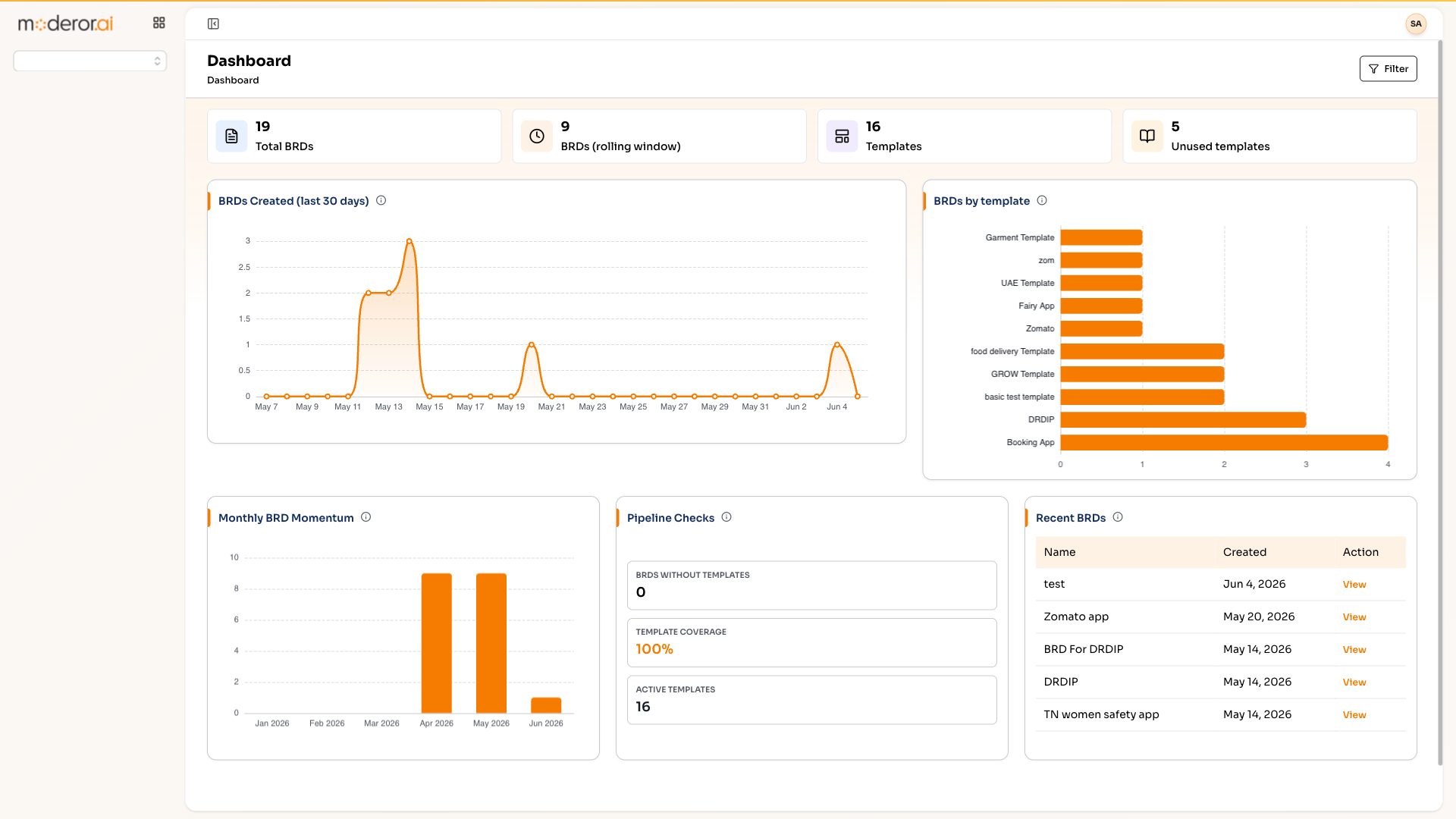
Questions, answered
FAQWhat is the Moderor APPcelerate Suite?
APPcelerate is Moderor's software-delivery suite: AI BRD Generator, AI App Builder, VAPT, QA Suite, AIM realtime monitoring, Synthetic Data Generation Engine and Query Builder. It covers requirements, prototyping, security testing, QA, observability and data — end to end.
How do the APPcelerate products work together?
They close the loop: the BRD Generator produces a requirements document, the App Builder turns that BRD into a working prototype, the QA Suite generates tests from your OpenAPI specs, VAPT normalizes scanner findings into tracked vulnerabilities, and AIM watches everything in production.
Does APPcelerate integrate with existing scanners and tools?
Yes. VAPT ingests Qualys VMDR and OpenVAS reports, the QA Suite reads Swagger/OpenAPI specs, AIM embeds OpenSearch Dashboards, and Query Builder connects to your databases over MCP with RAG-grounded schema awareness.
See it on your data.
Connect a source over MCP, point an agent at a control set, and watch the first findings arrive — with you in command.